Get to know the castle
Castle at a glance
- Site & layout
- Hilltop-and-lowland castle with a rebuilt keep
- Origins
- Medieval origin; present keep built in 1965
- Builders & patrons
- Ashina clan, Gamo Ujisato, Kato clan and successors
- Other names
- Tsurugajo; Wakamatsu Castle
- What remains today
- Stone walls and moats; reconstructed keep and other buildings
THE STORY
The story behind the walls
Tradition traces the site to a residence built by Ashina Naomori in 1384. Gamo Ujisato developed an early-modern castle and completed a keep in 1593. Following earthquake damage, major Kato works reshaped the complex by 1639. Buildings were removed after the Boshin War; the keep was reconstructed in 1965.
LAYOUT & ARCHITECTURE
Read the landscape and the buildings.
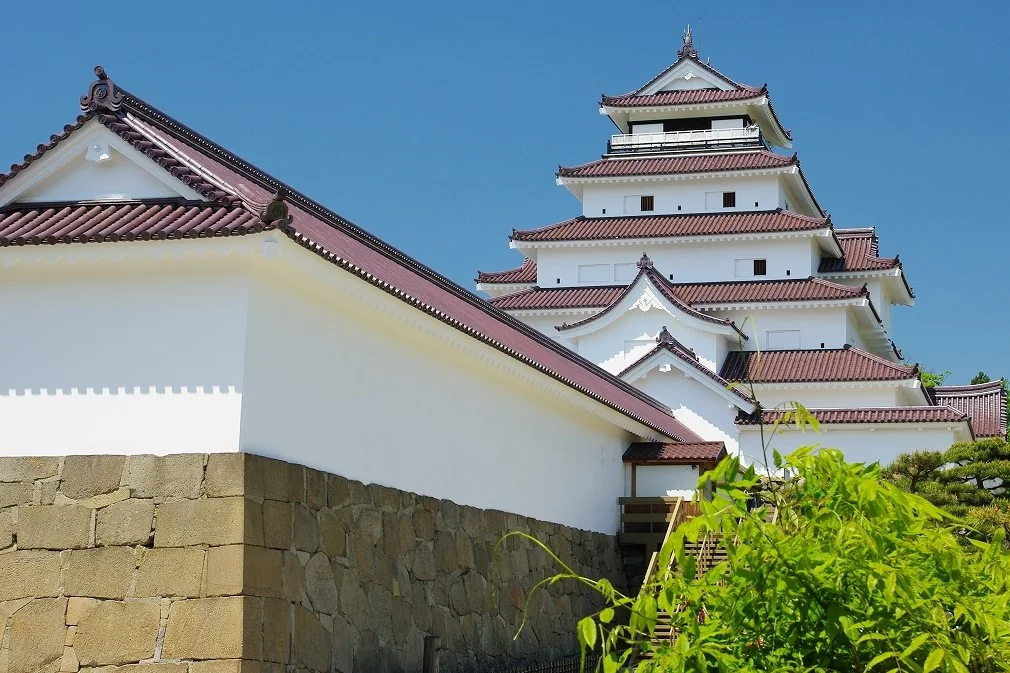
Outer enclosures, masonry and moats protect the main bailey. The present five-tiered keep reconstructs a later appearance shaped by Kato rebuilding. Distinguishing the early keep, Edo-period alterations and modern reconstruction clarifies its development.
A CLOSER LOOK
Details worth a closer look.
Red-tiled keep
The keep was rebuilt in 1965 and reroofed with red tiles in 2011 to evoke its late-Edo appearance. The tiles also reflect adaptation to a snowy climate.
Outer enclosures and moats
The Kato developed western and northern outer enclosures. Exploring beyond the main bailey reveals defences much larger than the keep alone.
Aizu’s castle history
Displays and surviving masonry connect the castle’s Sengoku and late-Edo histories. The modern reconstruction is itself another chapter in that story.
THROUGH THE YEARS
A short timeline
- 1593
Gamo Ujisato’s keep was completed.
- 1639
Major Kato alterations were completed.
- 1965
The keep was reconstructed.
- 2011
The roof was retiled in red.
BEFORE YOU GO
A note before you go.
Check the official website for the keep museum, teahouse and other facilities separately. Admission and event arrangements may change.
Information checked: 27 September 2026
Sources & official information
Some official sources are available in Japanese only.