Get to know the castle
Castle at a glance
- Site & layout
- Western-style bastioned fort
- Origins
- Work began in 1857; office moved here in 1864
- Builders & patrons
- Tokugawa shogunate; designed by Takeda Ayasaburo
- Other names
- —
- What remains today
- Moat and ramparts; the office is a modern reconstruction
THE STORY
The story behind the walls
The shogunate commissioned a Western-style fort designed by Takeda Ayasaburo to administer and defend Hakodate after the port opened. Work began in 1857, and the magistrate’s office moved here in 1864. Former shogunal forces occupied it in 1868 before their defeat in the Hakodate War in 1869. The office was dismantled in 1871 and partially reconstructed in 2010.
LAYOUT & ARCHITECTURE
Read the landscape and the buildings.
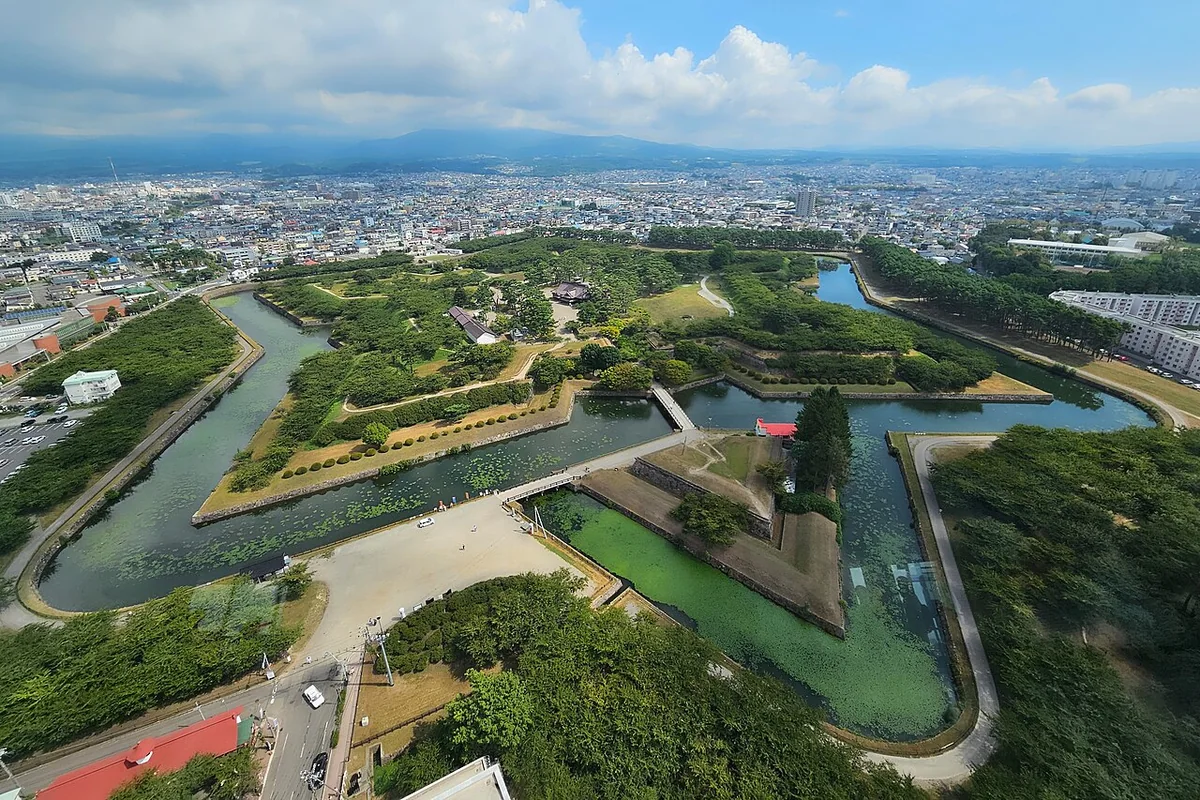
Five bastions and the surrounding moat form an integrated defensive perimeter. This differs from a Japanese layout arranged around a central keep. A Japanese-style government office within that perimeter reflects the mixed technologies and institutions of the late shogunate.
A CLOSER LOOK
Details worth a closer look.
Star-shaped bastions
Following the pointed outline reveals a defensive plan unlike a rectangular enclosure. The moat traces the geometry of the bastions.
Magistrate’s Office
The present building was reconstructed in 2010 using documentary and archaeological evidence. It helps connect the fort’s military form with its administrative purpose.
Moat and ramparts
Goryokaku has no Japanese-style keep. Its moat and ramparts make the entire fortified enclosure the main subject of a visit.
THROUGH THE YEARS
A short timeline
- 1857
Construction began.
- 1869
The Hakodate War ended.
- 2010
The reconstructed magistrate’s office opened.
BEFORE YOU GO
A note before you go.
The park and the magistrate’s office have different visiting arrangements. Check the official city and office information for opening dates, admission and accessible areas.
Information checked: 27 September 2026
Sources & official information
- Hakodate City: Goryokaku ↗
- Hakodate City: Magistrate’s Office ↗
- National Archives of Japan: Goryokaku ↗
Some official sources are available in Japanese only.